RESTAURANTS · CAFES · CATERING
THE DECISION TAKES NINETY SECONDS.
Someone is outside on a phone deciding whether to come in. Your menu, your hours, your patio and your reservation policy have to answer them before they scroll on — and they have to be right on every surface that carries them.
WHO THIS IS FOR
Independent restaurants, cafes, catering companies and food businesses — single rooms and small groups. If your menu changes with the season, your off-premise volume runs through delivery marketplaces, and you have a private room or a catering capability that nobody can find, this is written for you.
WHAT ACTUALLY BREAKS
THE PROBLEMS WORTH PAYING TO FIX.
01
Your menu is a PDF, so it does not exist
A PDF menu is invisible to search, unreadable to an AI assistant, and hostile on a phone. Meanwhile the questions people actually ask are dish-level and diet-level: gluten free pasta, halal steakhouse, is there a vegan option. A structured HTML menu with dish names, descriptions, prices and dietary flags marked up as data turns every dish into an answerable question — and makes the menu something the kitchen can update on the day it changes rather than the week the agency gets to it.
02
Every online order pays a commission you did not have to pay
Marketplaces are genuinely useful for discovery and genuinely expensive for repeat business. The work is to make the first-party path the obvious one for a customer who already knows your name: a direct ordering link that outranks the marketplace listing for your own brand, a Google Business Profile whose order-online action points at your own stack rather than an aggregator's, and on-site placement that treats direct ordering as the primary call to action. That is not a marketing improvement, it is a margin improvement, and it is measurable per order.
03
Your hours are wrong somewhere, and that somewhere is where it costs you
Hours live in at least six places: Google Business Profile, Apple Maps, the site footer, the reservation platform, the marketplaces and a social bio. They drift constantly — holiday hours, patio season, a kitchen that now closes at nine on Mondays. Each drift produces a person standing outside a locked door writing a one-star review. A single source of truth for hours, holiday hours and day-part availability, pushed consistently, is unglamorous and is one of the highest-return fixes available to a restaurant.
04
Private dining and catering are your best margin and your worst-marketed revenue
Most rooms have a private dining room or a catering capability and one buried line about it. The person booking a holiday party for forty is searching in a completely different vocabulary — private dining room for 40, office catering, restaurant buyout — and expects capacity, minimum spend, sample menus and a form that produces an enquiry an events coordinator can actually work from. A dedicated events surface with real capacities and real minimums is often the single highest-value page added in a restaurant engagement.
05
Assistants answer “where should we eat” and you are not in the answer
Someone visiting Edmonton asks an assistant for a good Italian place near downtown with a patio that takes reservations for eight. The answer is assembled from structured data, review text and whatever first-party text exists. A site whose cuisine, neighbourhood, patio, reservation policy, price band, dietary options and large-party capacity are only inferable from a photograph cannot be in that answer. AEO for a restaurant is unusually mechanical: state the attributes as text and as schema.
WORK IN THIS INDUSTRY
WE HAVE BUILT FOR THIS INDUSTRY.
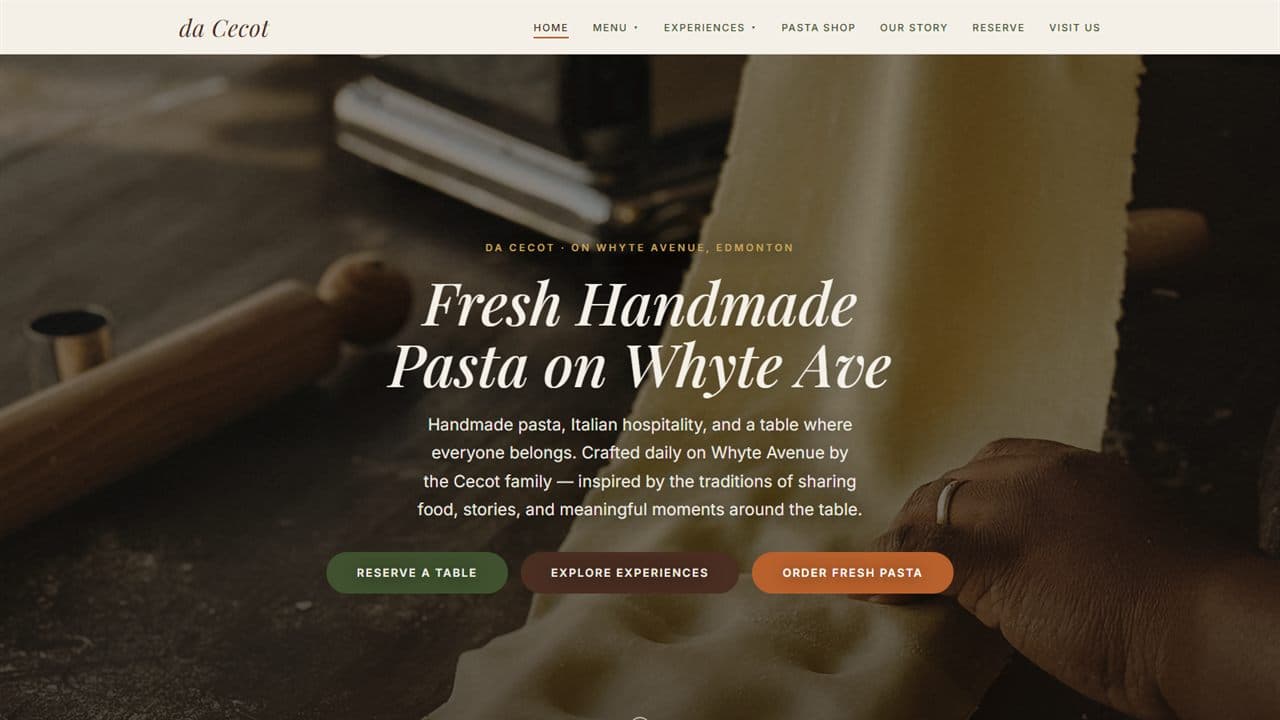
- da Cecot Food
- Cena Catering
Real builds for Alberta food businesses, both on our portfolio. Builds only — we publish no covers, order share or revenue figure for any client. See the portfolio.
WORKED SCENARIO
WHAT THE ENGAGEMENT LOOKS LIKE.
Illustrative and hypothetical. This is not a client, and nothing below describes any real engagement or any real result. It exists to show the shape of the work.
THE BUSINESS
A single-room 90-seat Italian restaurant in Edmonton with a 30-seat patio, a 24-seat semi-private room, and a menu that changes four times a year. The owner is also the general manager. Roughly two thirds of off-premise volume arrives through delivery marketplaces. The current site was built by a relative in 2019, the menu is a PDF exported from a design tool, and the private room gets one sentence.
WHAT THE BASELINE WOULD FIND
Current Search Console impressions and clicks by query family; Google Business Profile completeness, hours accuracy across six surfaces, and which order-online action the profile points at; current first-party versus marketplace order share from the point-of-sale; mobile Core Web Vitals on a mid-tier Android; and how a fixed set of twenty buyer-intent prompts is answered by the major assistants today.
WHAT THE ENGAGEMENT WOULD DO
A mobile-first rebuild with the menu as structured data the kitchen can edit, dietary and allergen flags per dish, day-part menus, and a first-party ordering path as the primary action. A real events surface: room capacities seated and standing, minimum spend by day-part, three sample group menus, and an enquiry form that collects what an event order needs — date, headcount, dietary restrictions, budget, audio-visual. A single hours source pushed consistently to every surface. The SEO pass handles indexation of dish and neighbourhood pages, internal linking and mobile performance. The AEO pass states attributes as text, marks up the restaurant and its menu in schema, publishes llms.txt, and writes an answers corpus around where-should-we-eat questions.
HOW IT WOULD BE MEASURED
Measured against that baseline, with the typical 14-to-90-day movement window and no promised outcome. The two figures worth watching for this buyer are listings accuracy and first-party order share, because both are attributable and both convert directly into margin.
WHAT WE WOULD SELL YOU
IN THE ORDER THAT USUALLY MAKES SENSE HERE.
All four are separately purchasable, each scoped to you. The order below is the one that tends to fit this industry, not a package.
How each service is priced is on the pricing page, and the other industries we work in are on the industries index.
STRAIGHT ANSWER
WHAT WE CLAIM, AND WHAT WE DO NOT.
Clients typically see movement in 14 to 90 days, measured against a baseline we capture before the work starts. This is a typical-results claim, not a guarantee.
We do not offer performance guarantees, we do not promise a specific ranking or a specific number of leads, and there is no “we keep going until it works” clause. What we do instead is measure: a baseline is captured before the work starts, and the same measurements are re-run afterwards, so the change is something you can check rather than something we assert.

RESTAURANTS · WESTERN CANADA
FAQ
RESTAURANTS — QUESTIONS.
Should a restaurant menu be a PDF or a web page?
+
A web page, always. A PDF menu cannot be read by search engines or AI assistants, cannot be updated by your own staff, and is painful to read on a phone — which is where most people open it. A structured HTML menu with dish names, descriptions, prices and dietary flags means every dish becomes findable, the kitchen can change a price the day it changes, and an assistant asked whether you have gluten-free options can actually answer.
How do we get more direct orders instead of delivery-app orders?
+
You make the direct path the easiest path for the customer who already knows your name. That means a first-party ordering link that outranks the marketplace listing when someone searches your restaurant, a Google Business Profile whose order-online action points at your own system rather than an aggregator's, direct ordering as the primary action on every page, and an offer that exists only on the direct channel. Marketplaces are for discovery; repeat customers should not cost you 15 to 30 percent.
Do restaurants still need a website if they have Instagram and a reservation platform?
+
Yes, because those platforms answer who you are and not whether someone should come. Instagram does not hold your hours, your full menu, your dietary information, your private dining capacity or your catering minimums, and it is not a source AI assistants cite when someone asks for a recommendation. The site is the one surface you own, the one you can change without permission, and the one that feeds everything else.
Can our staff update the menu ourselves?
+
Yes, and that is a build requirement rather than an upsell. Menus, prices, hours, holiday hours and day-part availability are editable by your team without touching code and without a support ticket. A restaurant site that needs a developer to change a price will be out of date within a month, and an out-of-date menu costs more in walk-outs than the change costs to make.
How do we show up when someone asks an AI assistant for a restaurant recommendation?
+
By stating your attributes as text a machine can read, then making sure the same facts appear consistently off-site. Cuisine, neighbourhood, price band, patio, reservation policy, largest party seated, dietary options and parking need to exist as written statements and as structured data on your own site, and the same details need to match across Google Business Profile, the reservation platform and the major directories. Assistants assemble recommendations from consistent machine-readable facts; a photo-led site with no text gives them nothing to work with.
How much does a restaurant website cost?
+
Website builds are scoped to your business, paid upfront against a scope agreed before work begins, and you own the result outright. A one-time SEO engineering pass and a one-time AEO / AI-visibility pass are each scoped to you and fixed in writing before work starts. There is no mandatory monthly fee; the only recurring product we sell is AI visibility tracking, billed monthly with a three-month minimum, and it is optional.
Do you do social media management for restaurants?
+
No. We build websites, run one-time SEO and AI-visibility engineering passes, and build lead generation on software and cold email infrastructure. Restaurant social is a daily operational job done best by someone in the room with a camera, and we would rather tell you that than sell you a retainer for it. What we will do is make sure everything your posts link to actually works.
How long before anything changes?
+
Clients typically see movement in 14 to 90 days, measured against a baseline captured before the work starts. That is a typical-results claim rather than a guarantee — we do not promise covers, orders or rankings. For restaurants the fastest-moving items are usually listings accuracy and first-party order share, because both are mechanical; organic search for dish-level and neighbourhood queries takes longer.
LET'S SCOPE IT.
A 20-minute call. We tell you which of the four is the right spend for a business like yours — including when the answer is the cheaper one.
Book a Free Call